



 80 Views
 0 comments
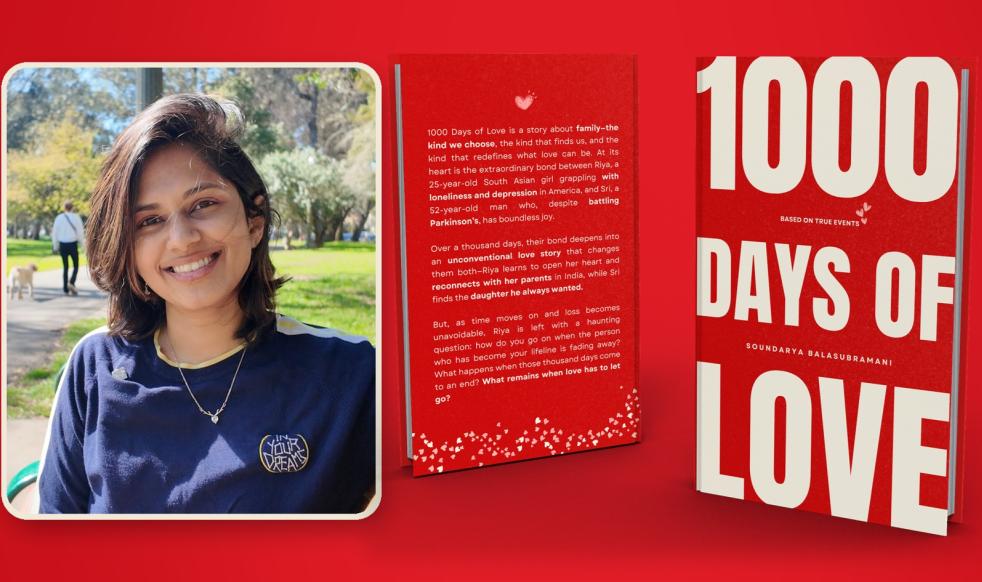
What happens when a young woman searching for purpose meets a man confronting a life-altering illness? For author Soundarya Balasubramani, the answer became a five-year journey into the meaning of love, family and human resilience.
Sometimes, the encounters that change our lives arrive without warning. A conversation with a stranger, an unexpected phone call, or a person who sees something in us that we have struggled to see in ourselves can alter the course of our lives.
For Soundarya Balasubramani, an author and entrepreneur whose work has reached millions online, one such encounter would eventually become the foundation of 1000 Days of Love, her third book and debut novel.
At its heart is an unusual relationship between two people separated by age, experience and circumstance: a young woman struggling to find her place in the world, and an older man living with advanced Parkinson’s disease who continues to approach life with remarkable joy.
It is, Soundarya says, a story about love — but not a conventional love story.
Instead, it asks a question that is both intimate and universal: what does it mean to have someone believe in you unconditionally?
A story that began with a powerful bond of mentorship
The inspiration for 1000 Days of Love emerged from Soundarya’s bond with Rajesh Setty, an entrepreneur, author and mentor she first met in July 2021.
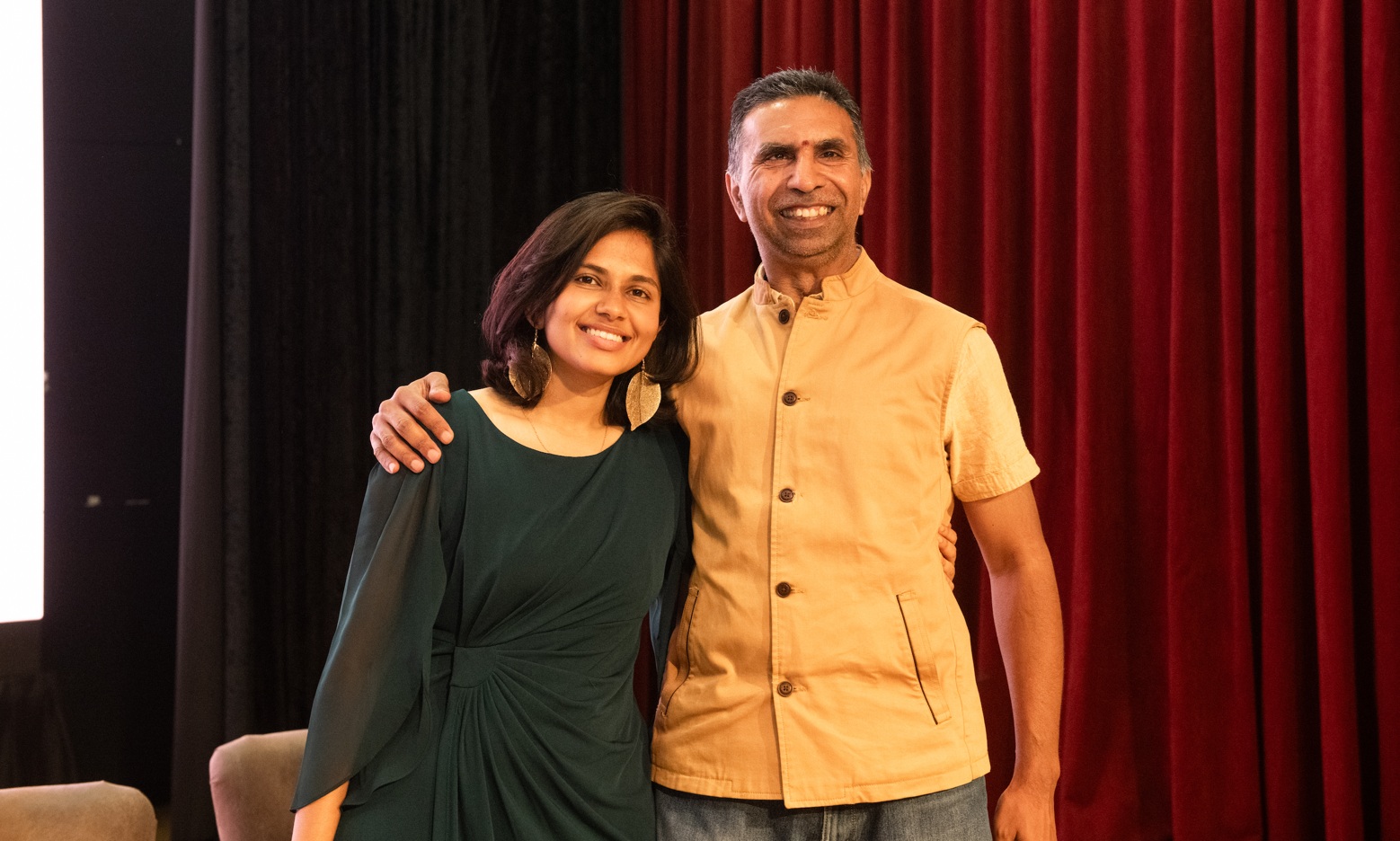
Soundarya with her mentor Rajesh Setty
What began with an introduction developed into thousands of conversations. Over time, Rajesh became her godfather, sounding board and a source of encouragement as she navigated her ambitions, doubts and questions about life.
Their relationship challenged conventional ideas of family. Rajesh was not her biological father, yet he came to occupy a deeply meaningful place in her life — offering the kind of support that can make a person feel understood, valued and capable of more than they had imagined.
His own circumstances made that support all the more striking.
Diagnosed with Parkinson’s disease in 2014, Rajesh has undergone two brain surgeries and experienced years of difficult treatments and physical challenges. The disease has affected his mobility and independence. Yet Soundarya describes a person who continues to find joy in life and to give generously to others.
It was this apparent contradiction that stayed with her: how could someone living with so much physical suffering remain so determined to encourage others?
And what might it mean for a young person to receive that kind of belief at a moment when they are struggling to believe in themselves?
These questions became the emotional foundation of her novel.
Rajesh inspired the character Sri Bellur, a man living with Parkinson’s whose generosity, humour and determination to find beauty amid hardship help transform the life of a younger woman. The character is fictional, and the book is not Rajesh’s biography. But the relationship at its centre draws on the experience of a bond that changed Soundarya’s understanding of love, family and loss.
The result is a story about a form of love that does not depend on blood relations, obligation or convenience. It is love expressed through attention, encouragement and the decision to keep showing up for another person.
Two lives, one unexpected connection
In 1000 Days of Love, readers meet Riya Shankar, a 25-year-old South Asian woman living in America. She is dissatisfied with her job, uncertain about her direction and holding on to a dream of transforming education. Despite her ambitions, she finds herself increasingly isolated, with few people she feels able to turn to.
Then she meets Sri, a 58-year-old man living with late-stage Parkinson’s disease.
Their connection begins with an unexpected phone call and grows into a relationship neither could have anticipated. Riya finds a father figure she has long wanted; Sri finds a daughter he never had.
As their lives become intertwined, both discover that care and companionship can move in two directions. The younger person is not simply a recipient of wisdom, and the older person is not defined solely by illness. Each has something to give, and each has something to learn.
Through their relationship, the novel explores ambition, identity, grief, family and the difficult work of becoming oneself. It also examines questions many people carry quietly: Can we heal the wounds of childhood? What does unconditional love look like in everyday life? How do we offer someone else happiness when we are struggling with our own pain?
And perhaps most challengingly, how do we find meaning when life refuses to unfold as we hoped?
These are not easy questions, and the novel does not reduce them to simple answers. Its premise instead invites readers to consider how much a relationship can change — not because one person solves another’s problems, but because someone finally makes them feel less alone.
For immigrant communities, the story may carry an additional resonance. Riya’s search for purpose takes place against the backdrop of life in America, where ambition and opportunity can coexist with isolation and the pressure to meet other people’s expectations. Her experience reflects a familiar tension: building a life on one’s own terms while trying to understand who one is beyond professional success.
Yet the questions at the centre of the book extend well beyond any one community. They concern the relationships that sustain us, the families we create and the people who help us imagine a different future.
The mentor behind the manuscript
Rajesh’s influence extended beyond inspiring a character. His perspective helped Soundarya understand what the story needed to become.
Initially, she imagined the project as a non-fiction collection of observations and lessons about living well. But a friend challenged her to look more closely at the relationship itself: what happens when a man in his fifties and a woman in her twenties form a bond that changes both their lives?
The important story, Soundarya came to realize, was not simply what Rajesh had taught her. It was what the two of them had created together.
That distinction shifted the book towards fiction, allowing her to build a world in which readers could experience the relationship rather than merely read about its lessons.
The idea also brought a difficult emotional truth into focus. Rajesh’s illness made time and uncertainty impossible to ignore. The book became, in part, Soundarya’s attempt to capture the experience of being cared for by someone whose presence had become an anchor in her life.
His example offered a powerful lesson: suffering and generosity can exist side by side. A person’s circumstances may change dramatically, but those circumstances need not erase their capacity to encourage, connect with and care for others.
It is a lesson that challenges the assumption that we must first have our own lives in order before we can contribute meaningfully to someone else’s.
Sometimes, the people who give us the most are those who understand most clearly how fragile life can be.
The long road to writing a novel
Bringing this story to the page took considerably longer than Soundarya initially expected.
Known for her earlier books Admitted, a guide to university admissions, and Unshackled, co-authored with an immigration lawyer, she had built a following through practical, research-driven writing. Fiction demanded a different approach: one that required her to inhabit characters, build a convincing narrative and accept that a story she cared deeply about might not work in its first form.
The novel took approximately 1,800 days to complete. Soundarya wrote in relative isolation on farms in Tamil Nadu, near Bengaluru and in Montana, eventually completing its fifth and final draft in a trailer near California’s coast.
The process included multiple rounds of editing, extensive rewrites and moments when she questioned whether she could finish the book at all. Her acceptance into Faber Academy’s novel-writing programme in London was followed by a street assault that left her with a broken nose and prompted her to return to India.
The setbacks did not end there. The manuscript went through demanding editorial reviews, and repeated approaches to literary agents brought little encouragement. At one point, she seriously considered abandoning the project.
But the story remained too important to leave unfinished.
She returned to the manuscript, reworked substantial portions of it and continued until she felt she had done justice to the relationship that had inspired it.
The effort reflects something of the novel’s central theme: meaningful work, like meaningful relationships, often requires persistence through uncertainty. Caring deeply about an idea does not make the process easy. It can make the difficult parts harder — but it can also make giving up feel impossible.
For Soundarya, completing 1000 Days of Love was about more than adding another title to her bibliography. It was an attempt to express something she had come to understand through a relationship that changed her life.
A gift to readers
What makes 1000 Days of Love compelling is not simply its unusual premise, but the questions it leaves with its readers.
Who has believed in you when you could not believe in yourself? Who has made you feel that your life, your dreams and your struggles matter? And who might be waiting for you to offer that same kind of encouragement?

The book invites readers to reconsider the boundaries of family and the everyday actions through which love becomes real. It asks us to look beyond grand declarations and consider the quieter gestures that can change a life: answering a call, listening without judgement, standing up for someone, or reminding them of their potential when they have lost sight of it.
It also offers an invitation to think differently about suffering. Not to dismiss pain or pretend that illness and loss are easy to bear, but to recognise that hardship does not necessarily eliminate joy, purpose or the ability to give.
For anyone navigating a difficult transition, feeling disconnected from the people around them, or wondering whether their dreams still matter, Riya and Sri’s relationship may offer a different way of seeing the world.
And for those who have been fortunate enough to find a mentor, an unexpected friend or a chosen family member who has stood beside them, the story may serve as a reminder of just how extraordinary such relationships can be.
Soundarya has spent years helping people navigate complex systems through her earlier work. With 1000 Days of Love, she turns to something less easily mapped: the inner lives of people, the relationships that shape them and the emotions that connect us across generations.
Her hope is that the novel will become more than a story about two fictional characters. It is an opportunity to reflect on the people who have shaped our lives — and on the possibility that we, too, might become that person for someone else.
Because sometimes, changing a life does not require a grand gesture or a perfect plan. It begins when one person chooses to believe in another.
And sometimes, that is where love begins.
Discover 1000 Days of Love
Soundarya Balasubramani’s 1000 Days of Love is available to pre-order, ahead of its planned launch in April 2027.
To learn more about the novel, explore its story and find details on how to pre-order, visit www.1000daysoflove.com.